Showing posts with label Cabernet Franc. Show all posts

Tuesday, 6 May 2014

Stars of the 2013 SA Trip- Where are they now?

Hey Everybody,

One of the most important things in winemaking, at least in new world countries where vintage variation is less of a factor, is consistency.  As a writer I would rather be effective across a smaller range of topics than create a broad-ranging array of articles with little focus.  To that end I am writing today about a few tastings I've conducted over the past month with a few other South African wines with which I have become well-acquainted in recent years.  Keeping up on how wines age and how producers develop from vintage to vintage is very important to me.

Two wineries are in the spotlight here: Raats and De Trafford, both wineries I consider to be at the forefront of top-quality production.

I wrote last year upon my first encounter with Raats Wines (an article that can be found here) and was impressed by both a vineyard management style that can be described as 'harsh' and a range of wines that can be described as 'awesome.'  At last I managed to revisit two wines of the Raats lineup and was not disappointed by what I found.  The Old Vine Chenin Blanc and the Red Jasper both presented themselves marvellously with all the subtlety and power I remembered from them.
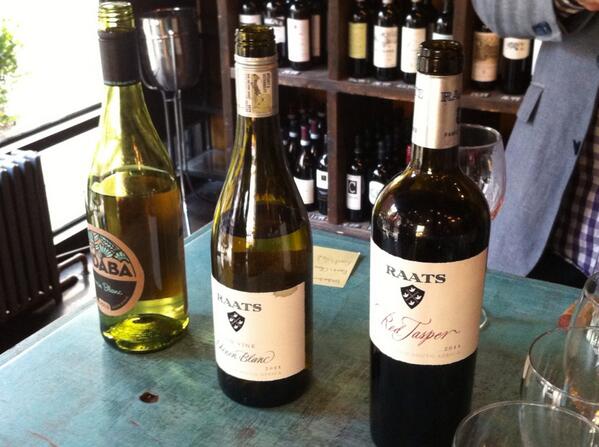
The Old Vine Chenin is still one of the true greats among South African Chenin.  As a varietal that is more and more frequently blended with Viognier and other Rhône varietals at the highest level (to great effect at Sijnn and Keermont), it is comforting to see that Bruwer Raats has put forward a Chenin that exhibits a freshness and linearity that is difficult to rival outside of the Loire Valley and Chablis.  Mineral-laced and lively, it shows off the great character of the decomposed dolomitic granite soils that make this regions terroir so exciting.  The 2012 vintage is easily as good as the 2011 I tasted last year and could easily age for a few years with excellent results.

The Red Jasper is a beautifully fresh, yet full-bodied example of Cabernet Franc in a leading role.  It is a rare thing to see Cab Franc take over the role of Cab Sauv or Merlot and lead a rich Bordeaux blend with such class and poise.  The Red Jasper is one of those wines that is effortlessly enjoyable upon release but has the balance and durability to spend a few years in a forgotten cellar before being gleefully rediscovered a decade later.  I may just neglect a bottle for a bit myself... if I can help myself!

Another wine I was particularly excited to taste again came about entirely by coincidence.  I was lucky enough last year to taste a definitive range of verticals from David Trafford's range.  Both his Stellenbosch wines and his Sijnn project (the 2007 of which I recently revisited here) are truly excellent wines, and I was very fortunate to be able to taste pretty much every vintage of every wine as well as several non-vintage blends.  I recalled tasting the 2005 Blueprint Shiraz as a surprising highlight of the tasting.

Even more surprising was finding two bottles in a loveless state liquor store in Pennsylvania.  I obviously bought them and was overwhelmingly satisfied with my purchase.  Showing beautiful earthy aromas, leather and dark chocolate, along with just a whiff of black olive and ferrous minerality.  I also know for a fact that the Merlot 2004 has withstood the test of time just as beautifully developing some of the qualities of mature bordeaux, while maintaining a smoky richness that is, for me, classically Stellenbosch.

I will continue to hunt for as many wines from my trip as I can, which may be difficult here in New York, but I will do my best and report my findings as I go along.  Til then...

Much Love,

G

Tuesday, 7 May 2013

Bordeaux Tasting

Hey Everyone!

Long while since I posted to this or any blog but I'm happy to be doing so again! Today I'm writing about a wee tasting I put on for a few friends of mine as they prepare for a high profile tasting competition at the Residence de France in London a fortnight from now. The theme of the evening is Left Bank Bordeaux, including Médoc, Graves, Sauternes and Barsac. I took part in this tasting last year and despite doing somewhat poorly (then having my spirits lifted by a stunning meal and lovely wine) I feel that the exercise of analysing Bordeaux from a blind tasting perspective was very enlightening.

When training for blind tasting, you always look at the general styles of grapes and regions in the following manner: Syrah tastes of violets, but is fruiter in Australia and more briny in the Rhône and so on. Basically you paint a region with a broad brush and Bordeaux is the same. There is a character to Bordeaux that makes it unique from wine anywhere else in the world. I am fairly confident I could pick out a Pomerol in a line up of Merlots from the rest of the world, but when it comes to picking apart the differences between the various cabernet-based communes of the Left Bank things get a bit tricky. So today's tasting was aimed at four appellations and three vintages.

1. Chateau Le Pey 2010 Médoc- The nose was creamy, sweet salted caramel and milk chocolate followed by cherry and crème de cassis. The colour was youthfully red; no traces of ageing yet lighter than some of the older wines showing the wine to be less concentrated. The palate agreed with lighter tannins, less intense flavours and acidity. A pleasant wine, but not the product of great grapes.

2. Chateau de Cardaillan 2007 Graves- Deeper colour but with some brickish hues showing the affects of ageing. 2007 is an early drinking vintage so it follows that maturity was reached quickly in comparison with the older Fourcas-Dupré. The nose was marred by a slight cork-taint but the character showed through in a perfumed fruit nose

3. Chateau Fourcas-Dupré 2004 Listrac-Médoc- This one was difficult to describe. There was not a whole lot to distinguish it from general Bordeaux wine. It lacked the cocoa powder of St-Estephe, the perfume of Margaux or the woody cedar of Saint-Julien. It was a good wine, but there really wasn't a whole lot to tell us what exactly a Listrac-Médoc was like. That said, it was a lovely bottle of wine!

4. Chateau Martinens 2007 Margaux- Classic to Margaux, the nose showed plenty of floral aromatics, perfume (almost like Campari smelled from a distance) and something along the lines of kirsch liquer. The palate showed fine grained tannins and an elegant finish. A really great wine and amongst this line up, I think it showed as an amazing wine.

Overall, I find the concept of blind tasting a highly invigorating experience, especially when put into such a singular context as Left Bank Bordeaux. It also shows what a versatile region Bordeaux is for wine production. It's not a tired region only good for putting out overrated and expensive wines. Rather it does offer some good value and quality across the board. Especially in an age where so many new world wineries boast of their high altitude or extreme conditions, Bordeaux is temperate by comparison and never more than a few metres above sea level.

For whatever reason, wine from Bordeaux is often overlooked by the casual drinker, but it should not be. It offers good quality, easy drinking and food friendly wine at a reasonable price point. These four bottles showed particularly well, but there are countless others like them.

Much Love,

George


Sunday, 4 November 2012

American in Paris (Drinking Wine)

Hey Everyone,

Today I am writing to you all on the last night of my trip to Paris, where I've been wandering aimlessly and without itinerary for about 4 days now.  No agenda, no contacts and no travel companions has led me to realise that my best friend in this city right now is a good bottle of wine and I am happy to report that I have been spoiled rotten.

Before I get into the more enjoyable parts of my visit and talk about the wine one can find in Paris, I will acknowledge the shortcomings of the French wine market.  While this country produces more wine  than any other apart from Italy and is known around the world for leading the rest in quality and fame for it's producers, there is a lack of context for it all.  I mean to say that I have seen exactly one bottle of Spanish wine (2007 Marqués de Riscal Rioja Reserva) and not much else from outside of France.

What I lamented in particular was the absence of many interesting wine regions of this very country.  In my visit to many different caves in the city I came across one Bandol, one Cumieres, one Cahors and two Juras (a red and a white from the same producer next to each other on the shelf).  I was hoping for a chance to find a selection of unique French wines I may not have heard of, but by and large all that was on offer consistently was very recent Bordeaux Supérieur, Dotes du Rhone, Bourgogne Aligoté (oddly enough) and a large amount of Petit Chablis.  Then of course there was the ocean of Beaujolais. I've come to the conclusion that Paris is less concerned with the variety and more focused on a consistent selection.

That said, I was lucky enough to find two or three very good shops in Paris and I was able to grab a couple of nice bottles during my time here.  One such shop, identified only by the titles "Cave des Cigares, Cave des Vin" was a shop very much up my alley.  Aside form finding a myriad selection of cigars from some of my favourite houses at a fraction of the British price, I also found an interesting assortment of Bordeaux and Rhone.  I could count perhaps 40 wines in total but the selection was an exciting one.  With under twenty Euros I was able to grab a 2000 Saint-Émilion which was really fabulous stuff as well as a brilliantly concentrated 2009 Cahors.

I've never had a good Cahors and this one for under ten quid was a nice cheapie.  It was rich and had a thick layering of black currant, smoke, flint and really firm tannins.  I know why this stuff doesn't come often to the UK seeing as it is somewhat impenetrable for all that tannin and acidity, but when you get your palate to grips with it, it's like gaining a taste for cask strength whisky; it pleases on a whole new level.

Just on the other side of the hill of Montmartre and the Sacre Couer lies the neighbourhood of Abbesses; the only part of town where people would put up with my poor French and encourage me along.  The Cave des Abbesses is pretty much a hall way lined with shelves and bottles and here I found a wide selection of mature wines for a damn good price.  From 2001 alone I found bottles of Cornas, Côte-Rotie, Bergerac, Pomerol and half a dozen other amazing appellations allowing the drinker the chance to buy wine ready to go or age depending on preference.  A nice collection of white Burgundy, white Rhône and bordeaux blanc (I treated myself to a bottle of white Graves for the composition of this post) made for an interesting range of whites, especially for the oak-crazy palate I get at this time of year.

The one to take the cake and eat it too, however was the Épicerie Legrand Filles et Fils, located on Rue de la Banque in the 2nd Arrondissement may be a bit out of the average price range, and in particular seeing as I was on my own, however it was a uniquely engaging place.  A good selection of Wines from pretty much every major appellation as well as a great selection of half bottles including Chateau Gazin, Beychevelle and others made for interesting browsing.  Of particular interest to me was the wide selection of top notch growers' champagnes and a fair selection of single malt.  The shop itself was never overly self conscious with the newer parts being evidently new but tasteful and the older rooms showing their age gently, and none of the faux-olde-worlde look a lot of wine shops go for.

The tasting room was more of a bar with the sort of feel that it could equally welcome a business lunch as it could host a couple of curious twenty-year-old oenophiles.  The selection of first growths in magnum, double magnum and larger was certainly inspiring.

As my bottle of Graves grows more and more empty I am afraid I am becoming sentimental about my trip to Paris.  Rarely does one spend so long without conversation, or so much time within one's own thoughts, yet I find the situation invigorating.  While I can tell that Paris is a city for pairs, it isn't all bad for ones, and if you can find a spot in the big city for yourself you will enjoy your stay to be sure.  I look forward to returning to Paris with company and to venture more regularly into the wine world of this city but for now I leave you with these bits of wisdom from a wine-loving traveller; look high and low in Paris and you will certainly be rewarded with some of the best wines you can find.

Much Love,
G

Monday, 19 March 2012

Loire Valley


Great examples of Sancerre and Pouilly-Fumé
Hi Everyone,

Today's post comes to you as I am currently exploring the under-appreciated valley of the Loire.  I know that many of us are introduced to the Loire through it's most popular district, Sancerre, but there is so much to be found as well as this full-flavoured Sauvignon Blanc.

The Loire is renowned throughout the world for so many reasons beyond it's great wines.  It is the very landscape of history, speckled with countless châteaux of the most stunning grandeur and beauty.  Some of the great marvels of European architecture, such as Château de Chaumont and the magnificent Chenonceau, dominate the towns and farmlands of this picturesque river valley.  The Loire itself is a beautiful river, flowing more than 1,000 miles from the south of France, emptying into the Atlantic Ocean at Saint-Nazaire. 

The wines of this region are as numerous and varied as the spires of the noble châteaux which dot the landscape, from the crisp Sauvignon Blancs of Pouilly-Fumé and Sancerre to the full sweet Chenin Blanc of Vouvray.  Not to be forgotten of course are the reds, with the noble grape Cabernet Franc dominating alongside a couple of Pinot Noirs.  As I look more and more into these wines, I realise that the Loire Valley is home to some truly great wines, exuding minerality, balanced acidity and overall class and elegance.

Predictably for me, I love the Loire for it's willingness to embrace it's classic traditions.  For a region so visibly steeped in history, prominently exhibited in it's castles and mediaeval market towns, it is natural that the wine-making should follow suit and embrace it's own unique gifts.  Here, wine grows up around towns and gains a reputation for it's individual style.  For example, the wines of Pouily-Fumé, from the vineyards surrounding the town of Pouilly-sur-Loire have developed a delightful, crisp minerality which resembles a struck flint or wet stones.

The wines around the village of Saumur include some delightful reds and some wonderfully balanced whites, from Cabernet France and Chenin Blanc, respectively.  One producer in particular, La Cabriolé makes a great value pair of wines.  The red is freshly acidic, with light tannins and  between bright fruits and herbs.  While they aren't necessarily the world's most perfect wines, nor will they be aging for decades, they are well-structured and show an engaging set of flavours, aromas and acidity.  

Another interesting wine which oes not get nearly the attention it deserves are the reds from around the town of Chinon.  Fresh, light and friendly wines made also from Cabernet Franc are delicious on a summer's day and, in my humble opinion, vastly superior to the similarly light and fruity Beaujolais Nouveau, which serves a similar purpose.  It can be drunk in easily and has a fruity simplicity which makes it perfect for sitting on the porch, watching a summer rain shower.

Saumur, Chenin Blanc and Cabernet Franc
So many of these delicious wines clock in under £20, in fact many cost less than £15.  The Loire must be under-appreciated because so many of these wines could easily be sold for more (indeed many worse wines are sold for more).  Not only are they good value wines, but they're also good food wines, matching pretty much anything you'd have.  A nice oaky Savennieres suits perfectly to a roast chicken, while a Muscadet Sevre et Maine can be a perfect companion to mussels and oysters.  If you're celebrating try a sparkling Crémant de Loire, a traditional fizzy wine blending  Chenin Blanc, Chardonnay and Cabernet Franc along with many other permitted grapes.  Its a nice cheaper alternative to the consistently pricey Champagne.

All this leads me to describe one of my favourite wines under £20.  The red wines of St Nicolas de Bourgeuil, made from Cabernet France with perhaps a touch of Cabernet Sauvignon are beauties for depth, complexity and finesse.  One example, Yannick Amirault La Mine, averaging around £15, has full blackberry flavours with some hints of licorice and a sprinkling of marjoram backed up by hints of bell-pepper.  Alongside a bit of grilled lamb, this wine is absolutely delightful and should be given the credit it deserves. 

Though the wines of the Loire speak for themselves, it seems that often their packaging is a bit old-fashioned and off-putting.  They don't jump out from the shelves as anything interesting.  They tend to look dated and tired, with old-fashioned labels coming between drinkers and a wine they may well enjoy greatly.  Case in point, Cour-Cheverny is a perfectly enjoyable white wine but the label is so dull and off putting, that very few people looking for an interesting wine they've never had would give it a try.

There are a few great gems in the Loire, and if we can get past the old-fashioned look of the bottles there is a bounty of great wine to be found within.  

Much Love,
G